Musical Theatre Essays
Why Is West Side Story So Important to Musical Theatre?
Table of Contents~11 min left
Why West Side Story Still Matters
Ask why West Side Story matters and the easy answer reaches for its songs: "Maria," "Tonight," "Somewhere." That answer isn't wrong, but it's incomplete in a way that actually obscures the more interesting reason the show has held its place in musical theatre for nearly seven decades. West Side Story is important less because any single element of it is exceptional in isolation, and more because dance, music, character, staging, and conflict were built to function as one dramatic language rather than five separate ones taking turns. When the show works, an audience isn't watching a book scene, then a song, then a dance number. It's watching the same argument — territory, fear, desire, violence — get made simultaneously in movement and sound and word. That's the claim worth examining, not just asserting.
It Made Dance Part of the Drama
Jerome Robbins conceived, directed, and choreographed the original 1957 production, and the choreography's job in West Side Story is worth being specific about, because "groundbreaking" on its own explains nothing. The show's opening "Prologue" is danced, not spoken — a wordless sequence of shifting walks, snaps, sudden stillness, and sharp group formations that establishes the Jets and Sharks' rivalry before either gang has said a line. The snapping and loose, contained walking read as boredom and surveillance; the sudden bursts into leaps and group formation read as territorial display. None of that is decoration around the plot. It is the plot's first act of exposition, delivered through bodies instead of dialogue because the information — how tightly wound this rivalry already is — would land as inert narration if a character simply said it.
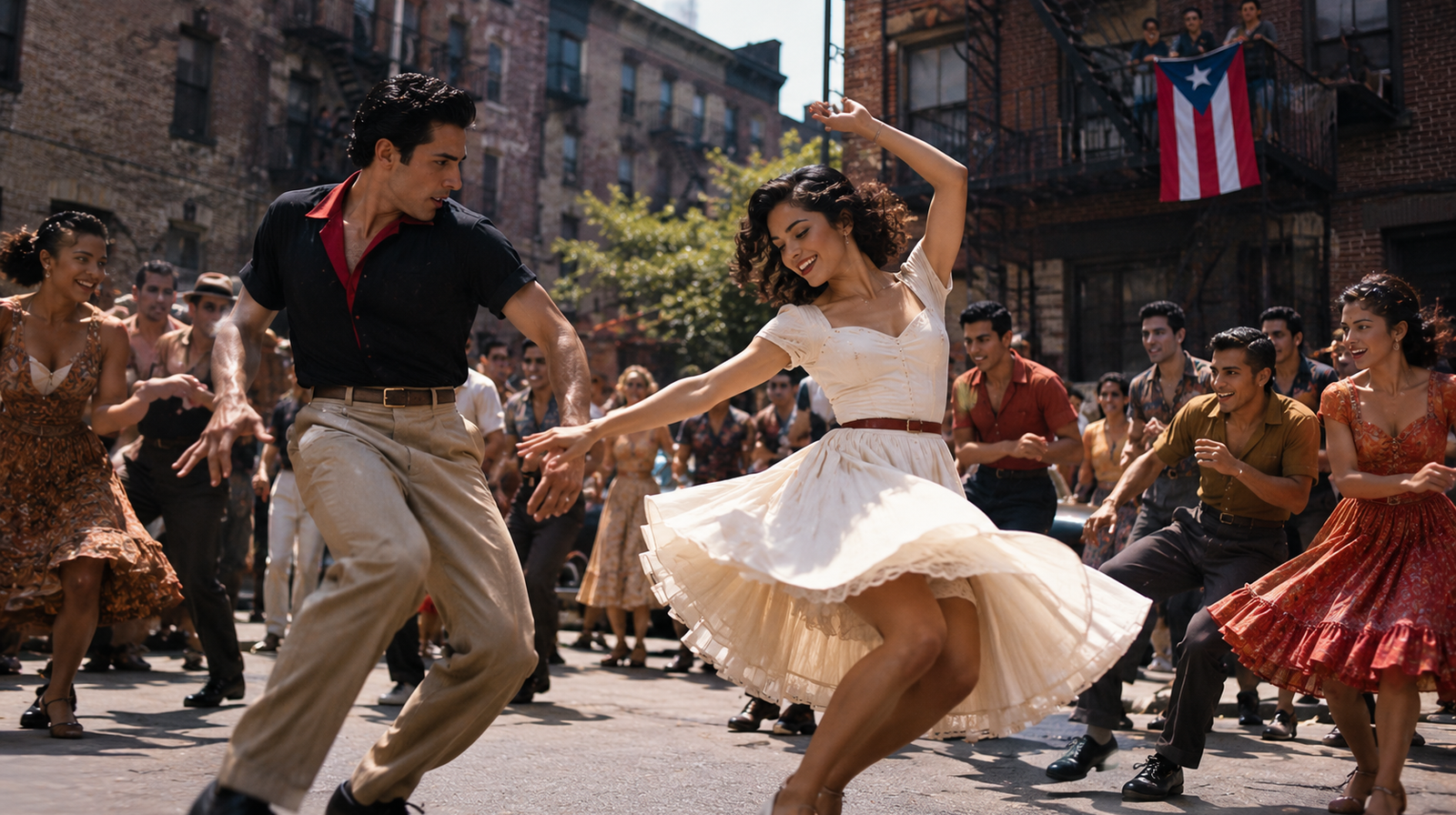
That pattern holds elsewhere. "Dance at the Gym," where Tony and Maria meet, stages the same social competition the two gangs run everywhere else — trying to out-dance and out-perform each other — before the sudden hush and stillness when Tony and Maria see each other cuts directly through it. The contrast works because the surrounding dance has already established a fast, aggressive social rhythm for the stillness to interrupt. Later, the ballet built around "Somewhere" — Tony and Maria's shared dream of a world without the conflict around them — works by the same logic in reverse: it's the one extended sequence in the show where movement isn't organized around rivalry at all, which is precisely what makes it read as a fantasy rather than the show's actual world. And "Cool," danced by the Jets in the tense stretch before the rumble, gives an already-agitated group something physical to do with feelings the number's own lyric explicitly tells them to suppress — the choreography and the words are pulling in opposite directions on purpose, which is its own way of dramatizing barely-controlled violence.
Robbins's choreography, across the show, is doing what dialogue usually does in a book musical: establishing relationships, escalating tension, and signaling emotional shifts — but doing it in a register words in this particular story couldn't reach as directly, since so much of what the Jets and Sharks are fighting over (territory, status, belonging) is bodily and spatial to begin with.
Music Does More Than Provide the Songs
Leonard Bernstein's score does something structurally similar. Its most-discussed device is a single melodic interval — the tritone, sometimes called "the devil's interval" for its historically unstable, unresolved quality — which appears prominently in "Maria" and recurs, transformed, throughout the score, including inside a number as different in mood as "Cool." That's not a trivia point about compositional cleverness; it's a way of binding Tony and Maria's romance to the surrounding tension musically, so the score itself carries an undertone of instability even in the show's tenderest moment. Bernstein also drew on Latin-inflected rhythms, jazz, rock, and classical traditions, giving the score a musical vocabulary as varied and volatile as the world the characters inhabit. Commentators have described the score as functioning almost operatically — carrying motif, foreboding, and narrative through the orchestration itself, not just the tunes layered on top of it. The interpretive claim worth making here, distinct from that documented technique, is that this is what lets the music characterize rather than merely accompany: a listener can often tell, from the music alone, which side of the conflict a given number belongs to, before a single lyric confirms it.
Sondheim and the Language of the Characters
Stephen Sondheim wrote the lyrics — his first Broadway musical, at 27 — working from Arthur Laurents's book and, in at least one documented case, directly from lines in Laurents's own outline for the show. What's worth attending to in the lyric writing itself is how closely it stays inside each character's specific voice rather than reaching for generalized romantic or dramatic language. "Something's Coming," Tony's first-act solo, is built on short, breathless, half-finished phrases — "could be / who knows? / there's something due any day" — that read less like a song announcing a theme and more like a young man's actual, disorganized anticipation, unable to settle on a single image for what he's waiting for. Sondheim later described trying to write from inside the actor's experience of the moment, not just the audience's understanding of it — an approach to lyric-writing as character work, not just rhyme and meter in service of a pretty tune.
"America" works the same way from a different angle: it's structured as an argument, not a statement, staged between characters who genuinely disagree about what emigrating to New York has actually gotten them. That the number is funny, fast, and full of specific, pointed complaints and rebuttals rather than a single unified sentiment is itself the point — it lets the show hold two real, opposed experiences of the same immigration story inside one song, instead of resolving them into one tidy message before moving on.
The Show's Structure Makes Conflict Feel Physical
None of this works in isolation, and that's the more important point than any single component. The Jets-and-Sharks conflict isn't delivered to the audience as information once, early on, and then referred back to — it's re-experienced, in a different theatrical language, in scene after scene: spatially in the Prologue, socially in the gym dance, verbally in the dialogue, musically in the score's competing idioms, and eventually physically in "The Rumble." That repetition across different systems is what gives the conflict its accumulating weight. A book scene alone could tell an audience the Jets and Sharks hate each other; it's harder for that same information, delivered once in dialogue, to make an audience feel the exhausting, everywhere-at-once quality of that hatred the way encountering it through movement, sound, and word in turn does.
"The Rumble" itself is where all of those systems collapse into one moment rather than alternating. It's staged as dance and as violence simultaneously — the same vocabulary of movement the Prologue used to establish territorial display now escalates directly into the fight that kills Riff and Bernardo, with no scene break separating the choreography from the consequence. The show doesn't cut away from the dance to show the "real" violence happening elsewhere; the dance is the violence, at full intensity, which is part of why the deaths that follow land as an abrupt, unresolved shock rather than a dramatically prepared climax the audience has been braced for.
From Romeo and Juliet to Something Distinctly Its Own
Arthur Laurents's book relocates Shakespeare's Verona to Manhattan's Upper West Side in the mid-1950s, then a mixed-income, multiethnic neighborhood during the Puerto Rican Great Migration, which peaked in the 1950s, driven in part by the postwar availability of affordable air travel. The Montague–Capulet feud becomes a rivalry between the Jets, working-class white teenagers from the neighborhood, and the Sharks, largely Puerto Rican newcomers to it; Romeo and Juliet become Tony and Maria. Several structural beats echo Shakespeare directly — a meeting across a crowded room, a fire-escape scene standing in for the balcony, a fatal confrontation between the two sides' leaders — and Laurents's libretto builds those parallels deliberately rather than incidentally.
But calling the result "Romeo and Juliet with gangs" undersells what actually changes in the transposition. Shakespeare's feud is inherited and largely unexplained — two noble families who dislike each other for reasons the play doesn't dwell on. The Jets-and-Sharks conflict is instead built on real, contemporaneous tension: who belongs in a rapidly changing neighborhood, whose claim to it is older, and how race, ethnicity, and economic precarity sort people into opposing camps before either side has said a word to the other. That's not a cosmetic update to Shakespeare's plot. It replaces an inherited grudge with a conflict the original audience would have recognized from their own city, which is part of why the show could use dance and music to dramatize the rivalry so directly — the tension wasn't abstract to begin with.
It's also worth being precise about what the show is and isn't doing with that material. West Side Story was written by a creative team that did not include Puerto Rican collaborators, and it depicts its Puerto Rican characters and community from outside that perspective — a limitation critics and scholars, including Puerto Rican writers, have pointed out in the decades since. That's a real part of the show's history and reception, not a footnote to set aside; it belongs alongside any account of how effectively the production dramatizes the conflict it depicts.
Why It Changed What a Musical Could Carry
A History of the Musical traces the broader story of how the American musical moved, gradually, toward songs and dances that grow out of character and situation rather than sitting beside the plot — a shift usually associated with Rodgers and Hammerstein's Oklahoma! (1943) a decade and a half earlier. West Side Story's specific contribution to that larger development is what this essay has been describing directly: it extended "integration" to include choreography as a fully dramatic, not merely decorative, component, and it demonstrated that a musical could sustain genuinely tragic subject matter — youth violence, racial and ethnic conflict, a story that ends in multiple deaths with no happy resolution — without softening it into reassurance for a commercial Broadway run. The production opened at the Winter Garden Theatre on September 26, 1957, in a Broadway system that was still largely associated with commercial entertainment.
What West Side Story Leaves Behind
It would overstate the case to say West Side Story invented dance-driven musical storytelling, or that it was the first integrated musical, or that serious subject matter began with this show — the previous decade alone had already produced Show Boat, Porgy and Bess, and Pal Joey, each pushing in related directions. What's more defensible is narrower and, in a way, more interesting: West Side Story is frequently pointed to by directors, choreographers, and historians as a reference point for what it means to let choreography carry real dramatic and narrative weight rather than functioning as an interlude between scenes, and for building an entire production — score, book, lyrics, and movement — around one sustained conflict rather than a single show-stopping number. Later musicals that lean on dance or movement to tell story, or that build an ensemble's identity through how it moves rather than only what it says, are working in territory this show helped make legible as a mainstream commercial possibility, even when they aren't direct descendants of it.
Conclusion
Return to the opening question — why does West Side Story matter — and the answer isn't that any one element of it (the score, the choreography, the lyrics, the book) is the reason. It's that the show demonstrates something a musical doesn't have to do: it doesn't have to pick one theatrical system to carry the story and let the others support it. West Side Story tells its central conflict through movement, through a score built on a single unresolved interval, through lyrics rooted in specific character psychology, and through a text that relocates an old feud into a genuinely contemporary one — simultaneously, in the same scenes, reinforcing each other. That's a harder thing to build than a good score or a good book alone, which is most of why it's remained a working reference point for what an integrated musical can actually carry, nearly seventy years after it opened.
Readers who want a deeper account of the biographical and creative history behind Bernstein, Robbins, Sondheim, and Laurents will find more of that groundwork in our guide to musical theatre books; this essay has stayed with the show itself, and what it's actually doing on stage.
Some links in this guide may be affiliate links. See our affiliate disclosure.