Hamilton Essays
What Does "The Room Where It Happens" Really Mean?
Table of Contents~10 min left
What Does "The Room Where It Happens" Really Mean?
The most important person in this song is the one person who isn't in it.
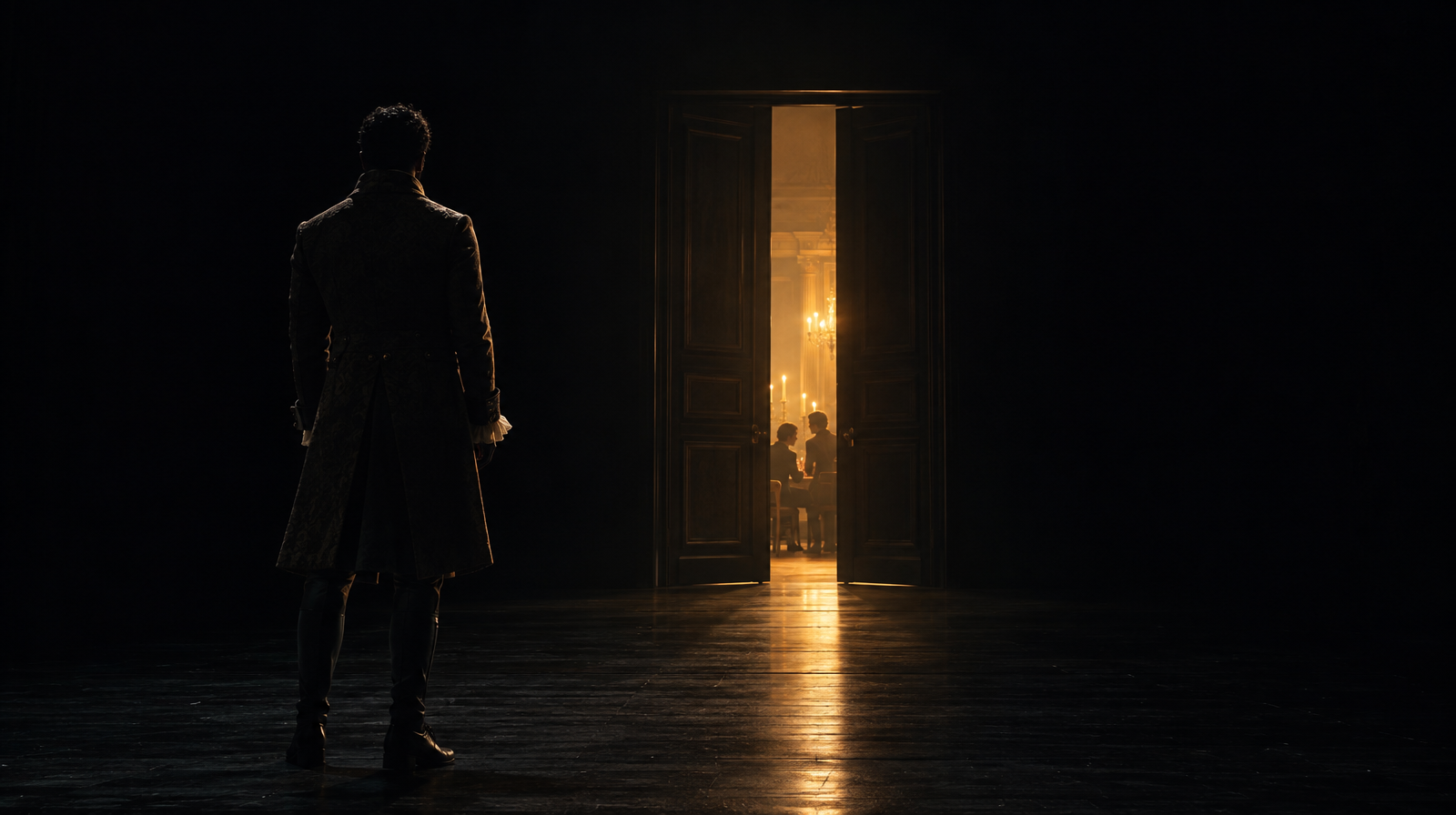
Aaron Burr sings "The Room Where It Happens" from outside a closed door, describing a meeting he did not attend, reconstructing a conversation he did not hear, guessing at motives he can only infer. That's an unusual way to build a showstopper. Musicals usually put you in the room. This one deliberately keeps you out of it, alongside the narrator, and asks you to feel the absence as the point.
What Does "The Room Where It Happens" Actually Mean?
Literally, "the room" is the private dinner where Alexander Hamilton, Thomas Jefferson, and James Madison worked out the terms of what history calls the Compromise of 1790 — a deal trading Hamilton's financial program for a Southern location for the new national capital. Burr wasn't invited. He watches the results happen around him without ever seeing how they were produced.
Symbolically, though, the room stands for something bigger than that one dinner: access. Not fame, not even necessarily agreement — just proximity to the conversation where a decision gets made, as opposed to hearing about the decision after it's final. The song's real subject is the gap between those two positions, and what it costs a person to live permanently on the wrong side of it.
Why Is Aaron Burr Telling This Story?
The choice to narrate this number through Burr, rather than through Hamilton, Jefferson, or Madison — the three men who were actually at the table — is one of the show's sharper structural decisions. Burr is reconstructing an event from the outside, piecing together a private negotiation from its public aftermath, and admitting as much while he does it. That's a strange kind of narration: confident in tone, uncertain in substance.
It's also the first time the show lets its unreliable narrator's unreliability become the actual content of a song, rather than a device operating quietly underneath one. Burr has narrated most of the musical up to this point; here, for the first time, the story he's narrating is explicitly one he didn't witness. The gap between what he's performing and what he actually knows is the whole number.
The Real History Behind the Song
The Compromise of 1790 is a real, well-documented piece of early American political history, and it's worth separating from the musical's compressed version of it. Hamilton, as the first Treasury Secretary, wanted the federal government to assume the states' Revolutionary War debts — a plan that would strengthen the new national government but that heavily favored states like Massachusetts and South Carolina, which still owed large sums, over states like Virginia, which had already paid most of its debt down. Madison, representing Virginia's interests in Congress, opposed the assumption plan and had enough votes to block it.
Separately, Congress was fighting over where to permanently locate the national capital — a fight tangled up with regional rivalry between the commercial North and the agrarian South. On June 20, 1790, Jefferson hosted a dinner where Hamilton and Madison discussed both fights at once. The outcome, in broad strokes: Madison agreed to stop actively blocking assumption and to help find Hamilton the votes he needed, and Hamilton supported locating the capital on the Potomac River, with a concession that also lowered Virginia's own debt obligation under the final assumption bill.
What Actually Happened in "The Room"?
This is where a fact-check matters. It's tempting, watching the musical, to conclude that Hamilton's entire financial program and the decision to build Washington, D.C. were both invented from scratch over one meal. That's not what happened, and the show doesn't quite claim it did, even if the staging makes the dinner look like the whole story.
The assumption plan and the capital fight were both already live, contested, multi-month political battles before that dinner took place. What the dinner did was break a specific legislative logjam by trading two things each side wanted, at a moment when both fights had stalled. The musical isn't wrong that something decisive happened at that table. It's compressed in suggesting that the table is where the decisive thing started.
Why Burr Is Obsessed With Being Included
Burr spends most of Act One as the show's designated observer — watching Hamilton's recklessness from a careful distance, narrating other people's ambition instead of acting on his own. What Does "Wait For It" Really Mean in Hamilton? covers the philosophy Burr builds around that distance: patience as strategy, restraint as a form of control, waiting as something closer to a discipline than a weakness.
"The Room Where It Happens" is the moment that philosophy starts to buckle. Watching Hamilton walk out of a private dinner with exactly what he needed teaches Burr something "Wait For It" hadn't yet forced him to learn: that outside the room, patience doesn't actually get you anything. It just means someone else's decision happens to you instead of near you. What Burr wants, from this point forward, isn't recognition or wealth in the abstract. It's a seat at the table where the next decision gets made.
From "Wait For It" to "The Room Where It Happens"
It's worth being precise about what kind of change this actually is, because it's easy to overstate. Burr doesn't become a different character in this song. "Wait For It" is about withholding — staying out of the fight until the odds favor you. "The Room Where It Happens" is about access — getting inside the fight instead of timing your entrance into it. Those aren't opposites so much as two stages of the same underlying instinct: control the risk. Burr spent one song learning to control risk by avoiding it. He spends this one discovering that some risks can only be controlled from inside the room, and that refusing to enter one is its own kind of exposure.
Why the Song Is About More Than Burr
Widen the lens and the song stops being only a character study. It's making a claim about how political power actually works, distinct from how it's usually taught: the public generally experiences outcomes, while a much smaller group of people experiences the negotiations that produced them. Most people who read about the Residence Act learned that the capital ended up on the Potomac. Almost nobody gets to know exactly what was traded to make that happen, because most of that trading never gets written down in a form the public can later reconstruct.
That's not a claim about any particular era of politics — it's closer to a structural observation about negotiation itself, in any period. The show isn't editorializing about modern government. It's using one specific, well-documented 18th-century deal to dramatize a gap between visible outcomes and invisible process that has existed for as long as people have made decisions in rooms other people weren't allowed into.
"No One Really Knows How the Game Is Played"
The song is unusually honest about its own limits. Burr isn't reporting the dinner; he's guessing at it, and the number lets that uncertainty stay visible rather than resolving it into false confidence. That's a more accurate picture of how history actually gets reconstructed than a tidier narration would have offered. Most private negotiations don't leave a transcript. What survives is usually the outcome, plus fragments — a letter here, a diary entry there — that later historians have to assemble into a plausible story, fully aware that the assembly involves guesswork.
Burr's uncertainty about what happened in that room isn't a flaw in his narration. It's the most historically honest thing about the song: an admission that even the people closest to an event often can't fully reconstruct how it actually happened, and that everyone else is working from something even thinner.
The Historical Record Is Messier Than the Musical
Historians don't actually agree on how much credit the Jefferson dinner deserves for the eventual compromise. Some scholarship treats the meal as a genuinely pivotal turning point. Other historians are more skeptical, arguing that Madison had already assembled enough support to see a version of the deal through, and that Washington's own aides had been quietly working toward a similar Potomac-for-assumption trade in the weeks before Jefferson ever set a table. The truth most historians land on is somewhere in between: a real conversation that helped unstick a real logjam, dramatized by the musical into something cleaner and more singular than the historical record fully supports.
That gap is worth naming directly rather than smoothing over. The musical needs one room, one night, one turning point, because that's what a three-minute song can hold. History had months of maneuvering, competing drafts, and at least one other backchannel negotiation running in parallel. Both things can be true — that the deal it depicts really happened, and that "the room" is a dramatic compression of a longer, murkier process — without either fact canceling out the other.
Why "The Room" Becomes Burr's Obsession
The turn in Burr's thinking isn't "I should have been invited to one dinner." It's larger and colder than that: he starts to understand that being outside every future room like this one means other people will keep making the decisions that define his life, indefinitely, while he narrates the results. That's the moment Burr's ambition changes shape — from a private grievance about a specific slight into a standing determination to never again be the person left explaining a decision he had no part in making.
It's a believable turn precisely because it isn't dramatic. Nobody insults Burr in this scene. Nobody excludes him out of malice. He's simply not there, watching people who are less careful than he is walk away with more than caution alone has ever gotten him — which is a harder thing to sit with than an insult would have been.
The Real Meaning of the Song
Pull the pieces together and "the room" means access, information, and the standing to shape an outcome before it hardens into history — not guaranteed rightness, and not guaranteed power. The song is careful not to claim that being in the room makes a person correct, only that it makes them consequential. Hamilton, Jefferson, and Madison aren't shown as wiser than Burr in that dinner. They're shown as present, which the song treats as an entirely different and, in the moment, more valuable thing than wisdom.
The reverse holds too: being outside the room doesn't make Burr powerless, only unconsulted. What Does "Satisfied" Mean in Hamilton? traces a related idea from Angelica's side of the show — a character who can see a choice with total clarity and still not control how it plays out once it's made. Burr's version of that same tension is procedural rather than romantic: he can see exactly what the room produces and still have no way to affect what happens inside it, which is its own kind of powerlessness even without anyone intending it as one.
History Belongs to the People Who Shape It, and the People Who Tell It
By the end of the number, Burr is no longer content to be Hamilton's narrator, watching history happen from a careful, comfortable distance. He wants to be one of the people making the decisions history later has to reconstruct — even knowing, as this very song demonstrates, how incompletely those decisions ever get reconstructed. That's the trade Burr starts making here: trading the safety of narration for the risk of participation, years before the show forces him to reckon with where that trade ultimately leads him.
It's worth remembering, too, that the man singing about being shut out of the room is the same man who will, decades later, try to control the room where the story of his own life gets told — and fail at that, too, in a different way than he fails here. Why Does Eliza Gasp at the End of Hamilton? looks at who actually ends up holding that authority by the show's final scene, and it isn't Burr. He spends this song wanting in on the room where decisions get made. He spends the rest of the show learning that the room where his own legacy gets decided was never going to be his either.
Some links in this guide may be affiliate links. See our affiliate disclosure.
Continue Exploring
Why Does Eliza Gasp at the End of Hamilton?
Eliza's final gasp is one of Hamilton's most enduring mysteries. Here's what the show reveals, what Phillipa Soo and Lin-Manuel Miranda have said, and why the moment remains deliberately open to interpretation.