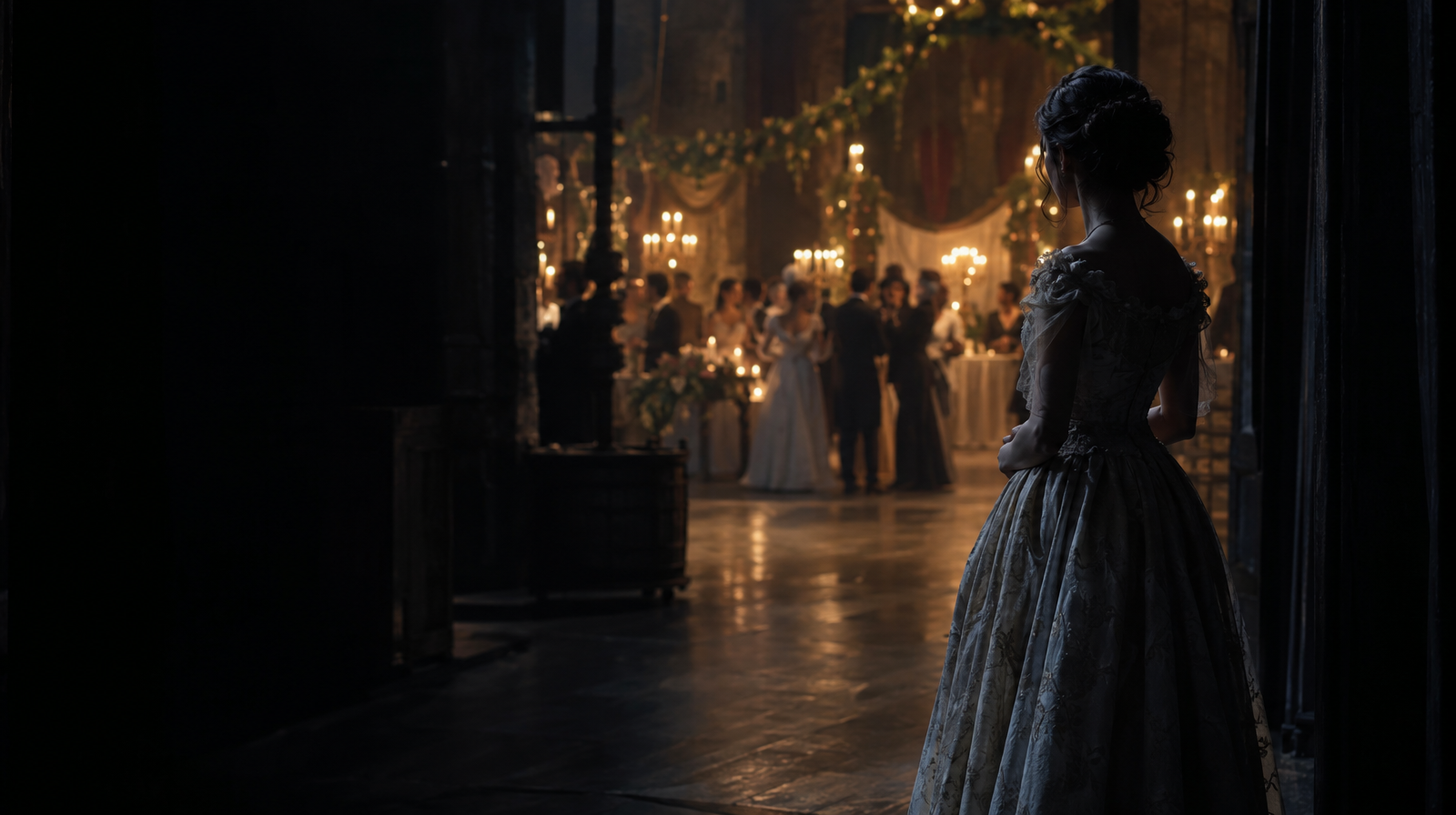
Angelica Schuyler stands up to give a toast at her sister's wedding, and for a moment, the show lets you believe that's all this is going to be.
It isn't. Within a few lines, the number stops moving forward and starts moving backward — the same party, the same room, replayed from a different set of eyes. "Satisfied" looks like a toast. It functions like a confession. And what it confesses isn't heartbreak, exactly. It's something more specific: the experience of understanding your own desire completely, and choosing against it anyway.
What Does "Satisfied" Actually Mean?
The word does a lot of work in this show before Angelica ever gets to it. "Satisfaction" shows up as an idea of getting what you're owed, of a hunger finally answered, of a want that stops wanting once it's met. Angelica's toast borrows that vocabulary and then quietly empties it out. She isn't singing about being satisfied. She's singing about the impossibility of it — and by the end of the number, she's told you flatly that she never will be.
That's the real subject of the song: not romance, and not rejection, but the gap between getting a thing and being finished wanting it. Angelica makes a clear-eyed, deliberate choice in this number. The song's tension comes from the fact that a clear-eyed choice doesn't erase the thing you chose against. She can be certain about what she did and still not be at peace with it. Both are true at once, and "Satisfied" is built to hold them there without resolving either one.
Why Does "Satisfied" Rewind "Helpless"?
The most famous thing about this number is its staging: Angelica's toast rewinds the show back into "Helpless," restaging the same ball where Eliza met Hamilton — except now the audience is inside Angelica's head instead of Eliza's. The choreography, built around Hamilton's dual turntables, literally reverses sections of "Helpless" before running them forward again from Angelica's vantage, so the audience watches the exact same handshake, the exact same glance, twice, meaning two different things each time.
That's a directorial and choreographic choice, not a lyric — the show could have simply told the audience Angelica felt something for Hamilton. Instead it makes you re-watch the scene you already trusted, and lets you catch what you missed the first time because you didn't know yet what to look for. The device works because "Helpless" earned your trust as Eliza's story. "Satisfied" spends that trust by proving there was a second story happening in the same room the entire time.
Angelica Sees Hamilton Differently Than Eliza Does
Eliza falls for Hamilton the way "Helpless" plays it — fast, overwhelming, uncomplicated by doubt. Angelica's version of the same night is analytical from the first line. She's not swept away; she's taking Hamilton apart in real time, sizing up exactly how sharp he is and exactly how much he wants, because that kind of appraisal is what she does. It's an intellectual recognition as much as a romantic one — she sees a mind working the way hers does, in a room where almost nobody else's does.
That distinction matters for how the number reads. Angelica isn't a woman who wanted what her sister got. She's a woman who understood Hamilton in a way the show suggests Eliza, at least in this moment, doesn't yet — and she uses that understanding to make her decision, not to contest it.
The Most Important Decision Happens Before the Wedding
The toast is the performance of Angelica's decision. The decision itself already happened, off-page, before the wedding — the moment she registers that Eliza wants Hamilton and steps back. The show doesn't dramatize that internal negotiation directly; it only shows you the result and then, through the rewind, shows you what that result cost to produce.
This is worth sitting with because it's easy to describe the plot as "Angelica loses Hamilton to Eliza," and that framing gets the whole number wrong. Nobody takes anything from Angelica in this story. She gives it up, on purpose, before anyone else even knows there was something to give.
"I Will Never Be Satisfied"
The line that closes the number is not a complaint. It's closer to an accurate report. Angelica made her choice, and she can hold that choice and still tell the truth about what it left behind — an unresolved want that doesn't go away just because she was the one who set it aside.
That's a harder emotional position than either grief or acceptance alone, and it's the reason the character stays interesting rather than becoming a symbol of noble sacrifice. She isn't performing selflessness for the audience. She's stating a fact about herself, once, and moving on with the evening.
Angelica and Hamilton Are More Alike Than They Appear
Set them side by side and the resemblance is closer than the love triangle suggests. Both are unusually intelligent in rooms that don't always reward it. Both are ambitious in ways their circumstances weren't built to accommodate — his by class and origin, hers by gender, in a world that had essentially no formal use for a woman's ambition beyond marriage. And both understand, in their own way, that wanting something and being allowed to pursue it are separate problems.
What Does "Wait For It" Really Mean in Hamilton? looks at Burr's version of this same tension — a character who treats restraint as a philosophy of control. Angelica's restraint isn't Burr's. His is defensive, built to protect him from risk. Hers is closer to a deliberate act of will: she can see exactly what she wants and still choose not to reach for it, which takes a different, harder kind of strength than simply avoiding the reach in the first place.
The Rewind Makes Angelica's Regret Physical
Memory in this number isn't a metaphor the lyrics describe — it's a thing the stage actually does. Rewinding the choreography turns "going back over a memory" into a literal, visible mechanic: bodies retrace their own steps, the room resets, and the audience watches Angelica relive the exact physical moment she's narrating rather than just hearing about it secondhand.
That's a meaningfully different experience than a flashback in film, where an edit can simply cut you into the past. Here, the same performers, the same stage, and the same music have to visibly undo themselves before they can replay differently. The effort of it is part of the point — reliving a memory this precisely doesn't look effortless, and the number doesn't pretend it is.
Why the Choreography Matters as Much as the Lyrics
It would be easy to treat the rewind as a clever technical trick and move on, but the choreography is doing narrative work the lyrics alone can't. The turntables physically stage the idea that Angelica and Eliza are experiencing the same three minutes of history from opposite emotional positions — Eliza moving forward into a night she'll remember as the start of everything, Angelica moving backward through a night she has to reinterpret every time she tells it.
Strip the staging away and "Satisfied" is still a well-written song about a hard choice. With the staging, it becomes a song about how differently two people can inhabit the identical moment, which is a much harder thing to say in lyrics alone than it is to show on a turntable.
The Historical Angelica Is Not the Same as the Musical's Angelica
It's worth being precise about where the musical's version of this story and the historical record actually diverge. Angelica Schuyler married John Barker Church in 1777 — three years before Alexander Hamilton married her sister Elizabeth in 1780. The love-triangle structure "Satisfied" builds its drama around, in other words, isn't how the timeline actually ran: Angelica wasn't a single woman weighing a choice between her own feelings and her sister's happiness at the moment the show stages that choice. She was already married.
What the historical record does support is a real and well-documented friendship between Angelica and Hamilton afterward — an extensive correspondence, preserved today in the Library of Congress, full of warmth and a flirtatious wit that biographers still disagree about. Some read it as evidence of real romantic feeling; others read it as exactly the kind of affectionate, teasing banter that close in-laws exchanged at the time, without needing to conclude anything happened beyond friendship. The honest answer is that historians don't agree, and the musical doesn't have to settle a debate its own sources don't settle — it just compresses an ambiguous, decades-long correspondence into a single decisive night, because that's what a musical does with material that doesn't have a clean dramatic shape to begin with.
"Satisfied" Is Really About the Life You Didn't Choose
Pull back far enough and the song stops being about a love triangle at all. It's about the specific, ordinary experience of having genuinely wanted something, having deliberately chosen not to pursue it, and still carrying the fact that you wanted it. That's not a rare emotional position. Most people who have ever made a real choice between two things they cared about know some version of what Angelica is describing — the version of a life that didn't happen, sitting quietly next to the one that did.
The show doesn't need the audience to have lived Angelica's exact circumstances to feel the number land. It needs them to have made one real choice they still think about, which is a much lower bar, and a much larger one.
Why "Satisfied" Is One of Hamilton's Most Important Songs
Structurally, "Satisfied" does something the show does only a handful of times: it hands you a scene you've already decided you understood, then proves you didn't have the full picture. The Silence at the Center of Hamilton traces a related move at the very end of the show, when the narrating voice shifts away from Hamilton entirely. "Satisfied" is an earlier, smaller version of the same trick — a reminder, well before the finale, that whoever is narrating a moment is never the only person who lived through it.
It's also the number that makes Angelica a real character rather than a device. Without it, she's the sister who introduces the love triangle and then recedes. With it, she's someone the audience has watched think, choose, and live with the consequences — which is more interior life than most of the show's secondary characters get at all, including, in a different way, the version of Eliza the show returns to at its very end.
The Real Meaning of "Satisfied"
"Satisfied" is not a song about losing Hamilton, and it's not a song about giving up happiness for a sister. It's a song about the specific discomfort of knowing exactly what you want, understanding precisely what it would cost the people you love to take it, and choosing not to — while refusing to pretend, even to yourself, that the choice made the wanting disappear.
That's why the final line isn't bitter and isn't resigned. It's just accurate. Angelica got exactly what she chose. She just never claimed it would be enough.