Hamilton Essays
Why Does Eliza Gasp at the End of Hamilton?
Table of Contents~10 min left
There is no lyric for it, and it isn't on the original cast recording. The sound that closes Hamilton — Eliza's sharp, wordless gasp as the final chord fades — was not written by Lin-Manuel Miranda as a line of dialogue or a lyric. By director Thomas Kail's own account, it grew out of conversation with Phillipa Soo during the show's off-Broadway run, something she "tried different things" with as the moment evolved in rehearsal — a staged, performed choice rather than a scripted beat, and every actor who has played Eliza since has had to decide for herself how to play it.
That is the honest answer to the question a lot of people search for after they finish the show: there is no confirmed, singular explanation for what Eliza sees in that last second. Not because nobody has asked the people who made it. They have, repeatedly, and the answer has stayed the same for a decade. In a 2016 BUILD interview, Soo described fans asking her directly — "Is it Eliza going into heaven? Is she seeing Alexander? Is she seeing God? What is it?" — and answered that "the idea of transcendence is present in all of that, whether it's in Eliza's mind or Phillipa's mind." In a 2020 tweet responding to a fan theory, Miranda wrote, "The Gasp is The Gasp is The Gasp. I love all the interpretations" — not a dodge so much as a description of how the moment was designed to work. Hamilton spends two hours and forty-five minutes building toward a question — who lives, who dies, who tells your story — and then, in its very last breath, declines to answer it in words. That refusal is the point, and it's worth taking seriously as a piece of stagecraft rather than treating it as a mystery to be solved.
What Actually Happens at the End of Hamilton
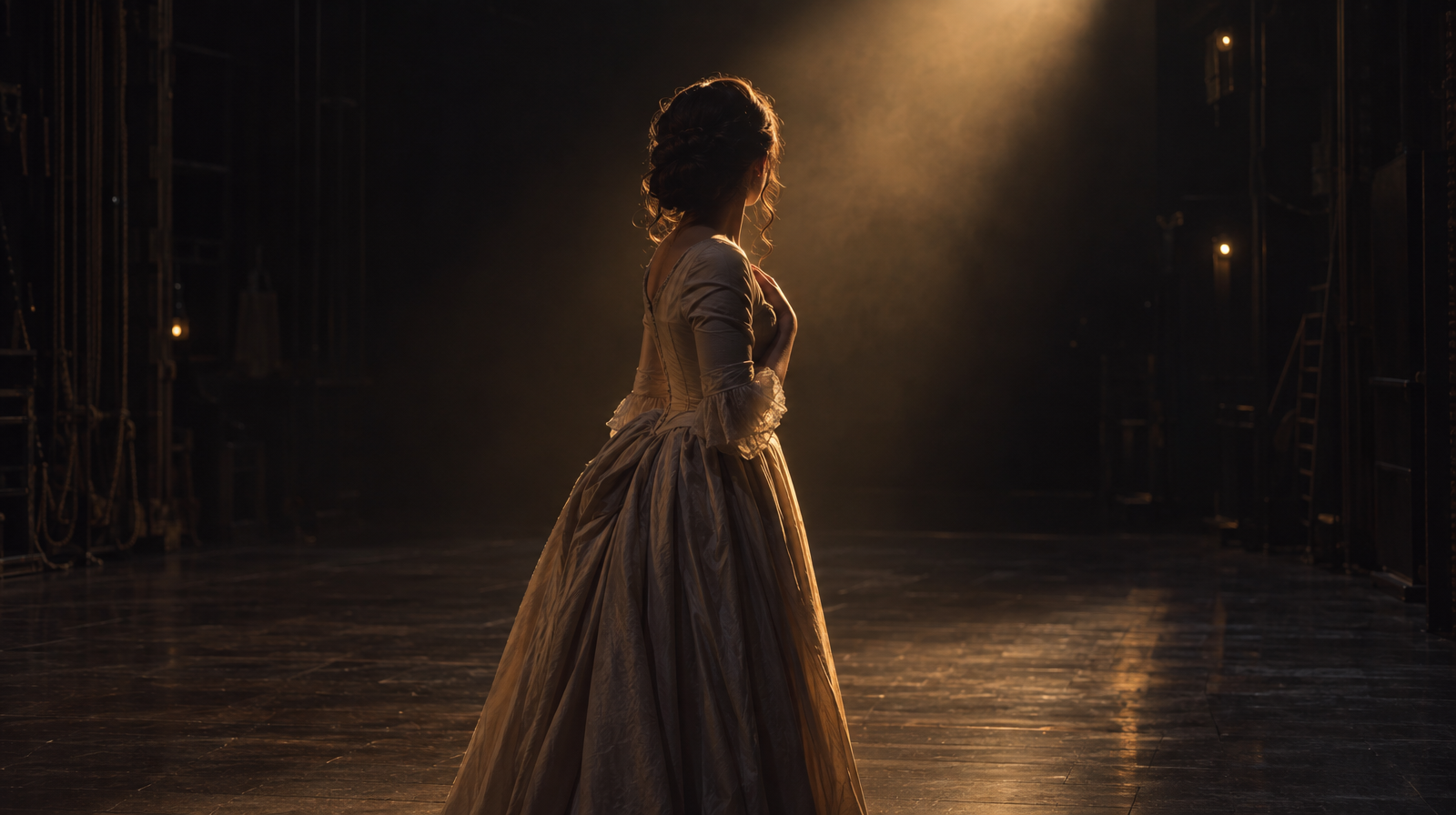
By the time "Who Lives, Who Dies, Who Tells Your Story" begins, Hamilton has been dead for the length of a scene change. Eliza has just delivered the number's most quoted line — "I put myself back in the narrative" — describing fifty years of work most audiences never see dramatized: co-founding one of New York's first orphanages and, above all, collecting, organizing, and publishing her husband's writing so that history would have something to work from at all. The rest of the company joins her, the ensemble that has played every role in the show for two and a half hours, and the final image is Eliza alone at the front of the stage as the lights and music close in on her. She turns out, faces the house, and gasps — hand rising to her chest — a beat before the stage goes dark.
Nothing about that description requires interpretation. What happens next is where the disagreement starts, because the show gives its audience an image and a sound, and nothing else.
Is Eliza Looking at Hamilton?
The most common reading online treats the gasp as a reunion: Eliza's life is ending, or has ended, and the man she spent fifty years keeping alive on paper is finally in front of her again. It's an emotionally satisfying reading, and nothing in the show forecloses it — earlier songs like "It's Quiet Uptown" and "Burn" have already trained the audience to read Eliza's silences and turned backs as loaded with feeling the lyrics don't spell out. But it's worth being precise about what this reading actually claims: not that the musical shows Eliza reuniting with Hamilton, but that a viewer, watching an actor gasp and reach for her chest with no dialogue attached, has filled that gap with the ending that feels most resolved. That's a legitimate way to watch a play. It is not the same thing as the show stating it.
What Has Been Said About the Final Gasp
The clearest fact available is also the most overlooked one: this moment isn't in the writing. It was developed in rehearsal, in conversation between Soo and Kail, rather than inherited from a stage direction in the text — which means every subsequent Eliza inherits a moment to interpret, not a blocking note to execute. In a Wired interview, Miranda put it plainly: "I think it's different for each Eliza. It traverses time in some way. Whether that thing she's seeing is Hamilton, whether that thing she's seeing is heaven, whether that thing she's seeing is the world now. I think those are all valid and all fair." Neither he nor Soo has ever supplied a single reading, in a decade of being asked. That consistency is itself informative. A creative team happy to let an ambiguous moment calcify into folklore, rather than clarifying it once and settling the question, is a creative team that considers the ambiguity load-bearing.
The Audience May Be Part of the Answer
There's a second reading, less discussed than the afterlife theory but better supported by what the number is actually about: that Eliza isn't looking at a person at all, but at the house — at the audience itself, several hundred people who have just spent the evening being told, explicitly, that they are the ones who get to tell this story next. This isn't an invented theory; it's one of the readings Soo herself has described, recalling nights when she looks out and sees the actual crowd rather than picturing anything supernatural. It's a reading, not a stage direction — but it's the one most directly supported by the number's own lyric.
This is where the show's fourth wall does real work rather than decorative work. For nearly three hours, the cast has performed at the audience without acknowledging it is there — the convention of a book musical, however contemporary its score. The final number breaks that convention on purpose. Eliza's gasp is the first moment in the show where a character's gaze seems to actually register the presence of the people watching, and it lands in the exact position — the closing seconds of a song about who inherits a story — where that recognition means something structural, not just theatrical. If the number's lyric is telling the audience they now hold the story, the gasp is the staging of that handoff actually happening: the moment Eliza's eyes appear to meet theirs.
Why the Gasp Matters After Eliza's Life Story
It's worth noticing what kind of sound closes the show, and who makes it. For two and a half hours, Hamilton has been a competition over who gets to talk. Hamilton wins nearly every one of those competitions — that's the entire premise of "Non-Stop," and it's why his songs run faster and denser than anyone else's. Eliza, by contrast, is given comparatively little to say for most of the show. "Helpless" and "That Would Be Enough" are tender, but they are reactive; she is responding to Hamilton's ambition, not driving her own. Her one true solo confrontation, "Burn," is defined by what she destroys rather than what she reveals — she burns the letters instead of reading them aloud, denying the audience the one scene where her interior life might have been laid out in full sentences.
Then the show hands her the last word, and she doesn't use it to speak. She gasps. After a musical spent almost entirely inside one man's compulsive fluency, its final human sound is involuntary and wordless, produced by the one character the show consistently under-wrote. That reversal — language surrendering to breath, right when the show's most talkative character is no longer there to fill the silence — is a more exact mirror of "who tells your story" than the lyric alone accomplishes. The show's answer to its own question isn't a monologue. It's evidence that the person left standing doesn't need one.
Eliza and the Question of Legacy
None of this works as theatre if it isn't backed by something true. Eliza Hamilton outlived her husband by fifty years, and by any reasonable accounting, she is the reason there is a story to tell at all. After Hamilton's death in 1804 left her with eight children and mounting debts, she spent decades collecting his letters and writings — sending questionnaires to his former colleagues to verify details — and worked with her son John Church Hamilton to organize and edit the collection for publication, an act of archival persistence that is the actual, unglamorous reason his biography survived in enough detail for a musical to be written about him two centuries later. In 1806, she co-founded New York's first private orphanage, the Orphan Asylum Society, and later served as its director for 27 years. She was not a passive figure waiting to be reunited with a husband. She was the person doing the specific, procedural, decades-long work of making sure a story existed to be told, long before Ron Chernow or Lin-Manuel Miranda came anywhere near it.
The musical compresses that history into two songs and a handful of lines, which is a legitimate use of dramatic license — a stage musical cannot dramatize fifty years of archival labor and still be a stage musical. But the compression makes the ending's ambiguity easier to read correctly: the show isn't vague about whether Eliza mattered to how this story reached an audience. It is only vague about the private, interior content of one gasp. Those are different kinds of uncertainty, and conflating them is how a viewer ends up expecting the show to resolve something it was never trying to.
The Ending Changes Who Gets to Tell Hamilton's Story
Look at where the show's attention actually goes across its last ten minutes, and a pattern shows up that the gasp completes rather than starts. The Silence at the Center of Hamilton traces how the show spends its finale taking Hamilton's voice away from him — he barely speaks in his own eulogy number, and the company sings around him rather than for him. That vocal handoff is the first half of the ending's argument. The gasp is the second half, and it's a physical one: once the company has finished singing the audience into the story, Eliza is the one left to actually look at them.
That's a real structural choice, not a coincidence of blocking. The show could have ended on the ensemble, or on a tableau, or on Hamilton reappearing for a curtain-call-style bow that let him have the final image after all. Instead, it isolates Eliza, turns her toward the house, and ends on her face rather than on a resolved piece of music. A song can tell an audience they're responsible for a story. Only a look can make that responsibility feel personally addressed — and that's a trade-off worth naming honestly: the show sacrifices a cleaner, more legible ending for a more demanding one, betting that a moment audiences have to sit with unresolved will outlast a moment that explains itself.
So, What Does Eliza's Gasp Mean?
Probably not one thing, and that isn't a cop-out — it's the most literal reading of what Soo and Miranda have actually said about it. What's more interesting than picking a winner between "she sees Alexander" and "she sees the audience" is noticing that both readings point the same direction: outward, toward whoever survives to keep telling the story, rather than backward, toward the man the show spent two acts following. Whether Eliza's gasp is grief, recognition, or something closer to what Soo calls transcendence, it is not aimed at anything the show has already resolved. It's aimed at what comes next — which, on the night you saw it, was you.
Some links in this guide may be affiliate links. See our affiliate disclosure.
Continue Exploring

The Cabinet Battles Are Rap Battles, and That Costs Something
Hamilton stages its biggest policy fights as rap battles, judged by one man instead of a crowd — and the show's own ending admits nothing was decided.

The Ten Duel Commandments, Three Times
Hamilton stages the same duel structure three times. By the third, the audience already knows exactly what one gesture means — and exactly what it costs.