Hamilton Essays
What Death Looks Like in Hamilton
Hamilton's most haunting image was never fully assigned by the people credited for the show. Here's what that reveals about who really authors what an audience feels.
9 min readRead Guide
Hamilton Essays
What's easy to miss about King George's three songs in Hamilton is that none of them are really about him. He spends every verse addressing someone else — the colonies, Congress, John Adams — and describing, in detail, exactly what they're about to lose. That's an unusual choice for the only character in the show with nothing left to lose himself, and it's also the reason he gets to be funny in a way no one else in Hamilton is allowed to be.
Every other major character carries real stakes into their big numbers, and the music tells you so. Hamilton's ambition songs run fast and dense because his time is genuinely running out. Eliza's grief in the second act sits in silence and open space because there's nothing left to rush toward. Even "The Schuyler Sisters," one of the show's most purely joyful numbers, carries an undercurrent of real risk — three women staking a public claim to their own minds in a world with real consequences for it. George alone gets to sing without any of that pressure, because the show has already told the audience how his story ends before he opens his mouth for the first time. We know he loses the war. History settled it a decade before Lin-Manuel Miranda wrote a word of dialogue. A character with a guaranteed, foreclosed outcome is a character an audience can laugh at freely, because nothing that happens next can actually surprise or wound him.
That's the real mechanism behind why "You'll Be Back" lands as pure comedy rather than as menace, even though the lyrics describe a monarch threatening war. George sings about sending "a fully armed battalion to remind you of my love" with the exact cadence of a jilted ex-boyfriend threatening to show up at an apartment uninvited, and audiences laugh immediately, without the small guilty hesitation that usually accompanies laughing at a threat of violence. That hesitation doesn't show up here because the threat has no teeth left. Laughing at him costs nothing, because his defeat isn't a risk the scene is running. It's a fact the audience already owns.
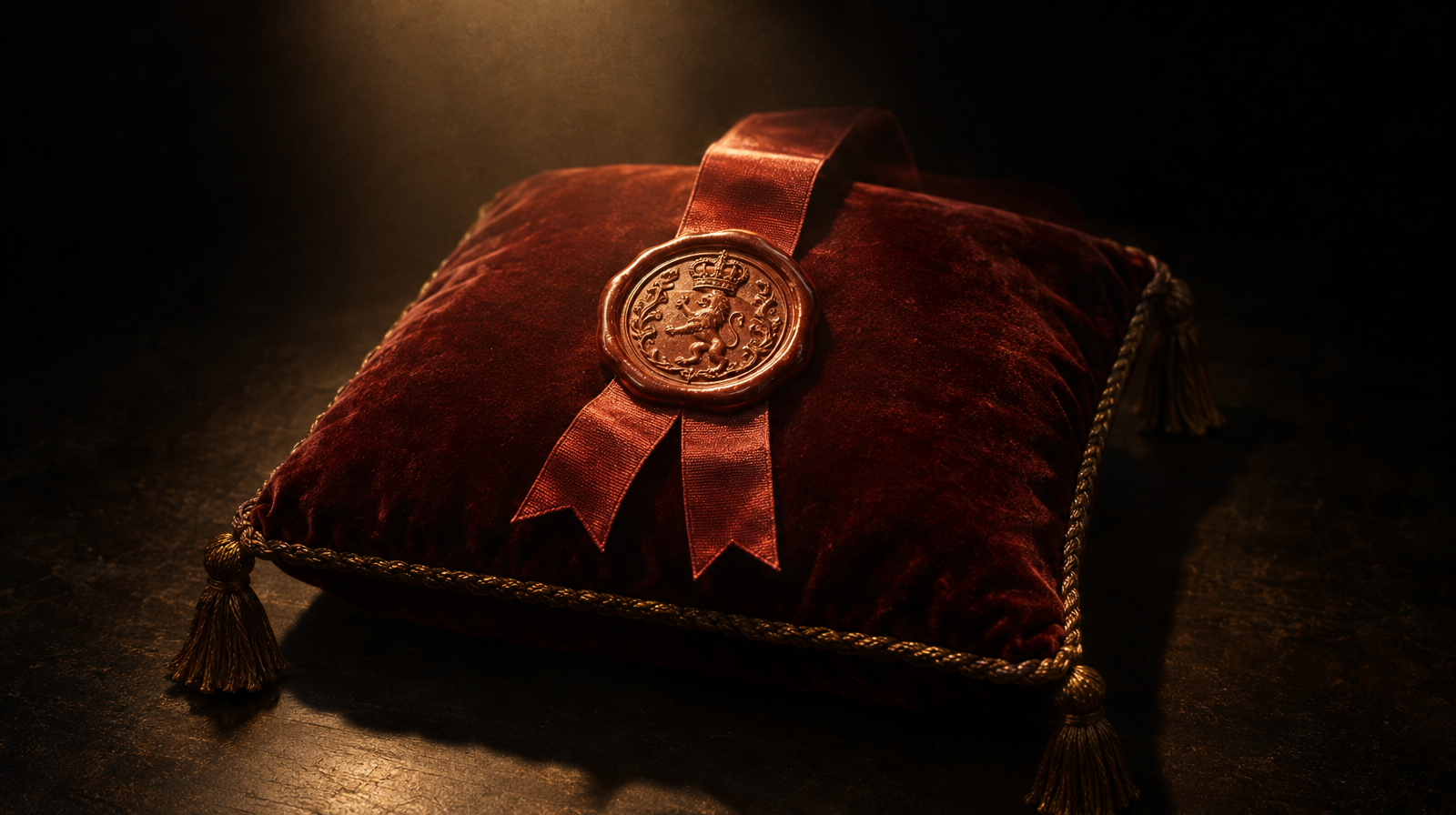
The staging makes the same argument without a single line of dialogue. Every other number in Hamilton moves — the ensemble crosses and recrosses the stage constantly, bodies stacking into tableaux and breaking apart again, because the show's whole visual grammar is built around motion as a stand-in for historical momentum. It's the same grammar the ensemble uses to trace death itself across the stage elsewhere in the show — movement carrying a meaning no line of dialogue ever states. George's three songs are the exception. He holds one fixed position, alone, while the rest of the company briefly disappears from the stage entirely. The contrast is the point: everyone else in Hamilton is a body in motion, actively making history happen around him, while George stands still, because history has already finished happening to him. Stillness reads as obsolescence on a stage built almost entirely out of movement, and the show spends that contrast on a laugh instead of on pathos — which is itself a choice, not an accident.
George also gets something no other character in the show is granted: he looks directly at the audience and talks to them like he already knows exactly how the story turns out for him. Hamilton, Burr, and Eliza all eventually address the audience too, but always from inside the story, still emotionally implicated in what they're describing. George addresses the audience from clearly outside it, with the detached amusement of a man watching a rerun of his own defeat. That detachment is harder to perform well than it looks — an actor playing George has to seem to already know he's a punchline, which takes real precision, not just campy overacting, or the songs collapse into cheap parody instead of the pointed release they're built to deliver.
That specific kind of laughter — safe, aimed at someone the story has already finished punishing — is doing real emotional work, not just breaking tension for its own sake. By the time "What Comes Next?" arrives early in Act Two, the audience has just sat through the exhausting, unglamorous grind of an actual war and the uneasy realization that winning independence didn't resolve anything about how the new country would actually govern itself. George's number interrupts that unease by naming it directly — needling the Americans about whether they have "a clue what happens now" — and audiences laugh with visible relief, not just amusement. The show needs somewhere to put the accumulated dread of what happens after the fighting stops, and it's George, not any of the Americans, who gets to say the unsayable thing out loud, because only he can say it without it landing as despair.
That timing repeats a third time, and it isn't a coincidence. "I Know Him" arrives right after John Adams is elected president — a genuinely anticlimactic beat for a show that has spent two hours building Hamilton's rivalry with Adams into something consequential. George's brief, gleeful disbelief that this is somehow the man America chose does the job a scene of Hamilton's own frustration would have done far more heavily. Putting the reaction in George's mouth instead of Hamilton's keeps the moment light instead of bitter, and lets the show move on to Hamilton's actual downfall a few scenes later without spending its emotional capital early.

None of this is free, and it's worth naming the actual cost rather than treating George as a pure bonus. By keeping every ounce of the show's real comedy sealed off in the one character the story has already defeated, Hamilton never has to risk a genuinely serious reckoning with what the war cost the side that lost — not just George personally, but the empire, the loyalists, the soldiers on the other end of those "fully armed battalions." A version of this show willing to let George's menace occasionally feel real, even once, would complicate the audience's relationship to the Revolution in a way the current version never has to. That's a real trade-off, not an oversight: this Hamilton needs an uncomplicated villain precisely because its hero is already so morally complicated, and George's harmlessness is what keeps the show's moral weight concentrated where it wants it — on Hamilton, Burr, and the men actually building the country, not on the king they're leaving behind. It's the same trade the show makes with its own hero — the history it leaves offstage to keep Hamilton likable — run in the opposite direction, for the villain instead of the protagonist.
It's the right call for the show Hamilton is actually trying to be, and that's worth saying plainly rather than treating the choice as a missed opportunity. A more dangerous King George would be a more honest one, and a less useful one. The show has exactly one true safety valve, and it depends entirely on George staying precisely as toothless as he already is.
The next time George gets his laugh, it's worth noticing what the show is actually asking the audience to feel relieved about. Not that America won — that was decided in the previous scene, mostly offstage, without a song. What the laugh releases is smaller and stranger than that: the reassurance that somewhere in this story, at least one person's fate is already fully decided, with nothing left to lose and nothing left to prove. Everyone else in Hamilton spends the whole show still finding that out.
Some links in this guide may be affiliate links. See our affiliate disclosure.
Hamilton's most haunting image was never fully assigned by the people credited for the show. Here's what that reveals about who really authors what an audience feels.
Hamilton simplifies its most complicated men to tell its story. Look closely at what the musical leaves out, and why, and it reveals exactly what kind of history the show actually wants to tell.
Hamilton builds its title character's voice for two hours, then hands its ending to someone else. What that reveals about the show's real subject.