A few minutes into the second act of Hamilton, a single ensemble member steps out of the crowd, holds her fingers together as if pinching something too small to see, and begins tracing a slow, deliberate line across the stage toward the title character. Nothing in the script announces what she is. No lyric names her. She simply moves, again and again, through duel after duel, until the night she finally reaches Hamilton and he falls. Audiences have a name for her anyway: the Bullet. It is one of the most talked-about images in the show, and almost nobody who talks about it knows that its most specific meaning was never actually assigned by the people whose names are on the program.
The mechanics of the role are well documented. An ensemble performer traces the path of a fatal shot in slow motion, first in "Stay Alive," again through the stylized violence of "Ten Duel Commandments," and finally in "The World Was Wide Enough," where the bullet that has been approaching all night reaches its target. Choreographer Andy Blankenbuehler built the device as a way to stage gun violence without literal guns — a workaround that became one of the production's signature images, disguising a fatal trajectory as dance. That much is a matter of record, credited, reviewed, and covered at length in Hamilton: The Revolution, the show's own companion book, which documents dozens of choices like this one in more detail than any Playbill ever could.
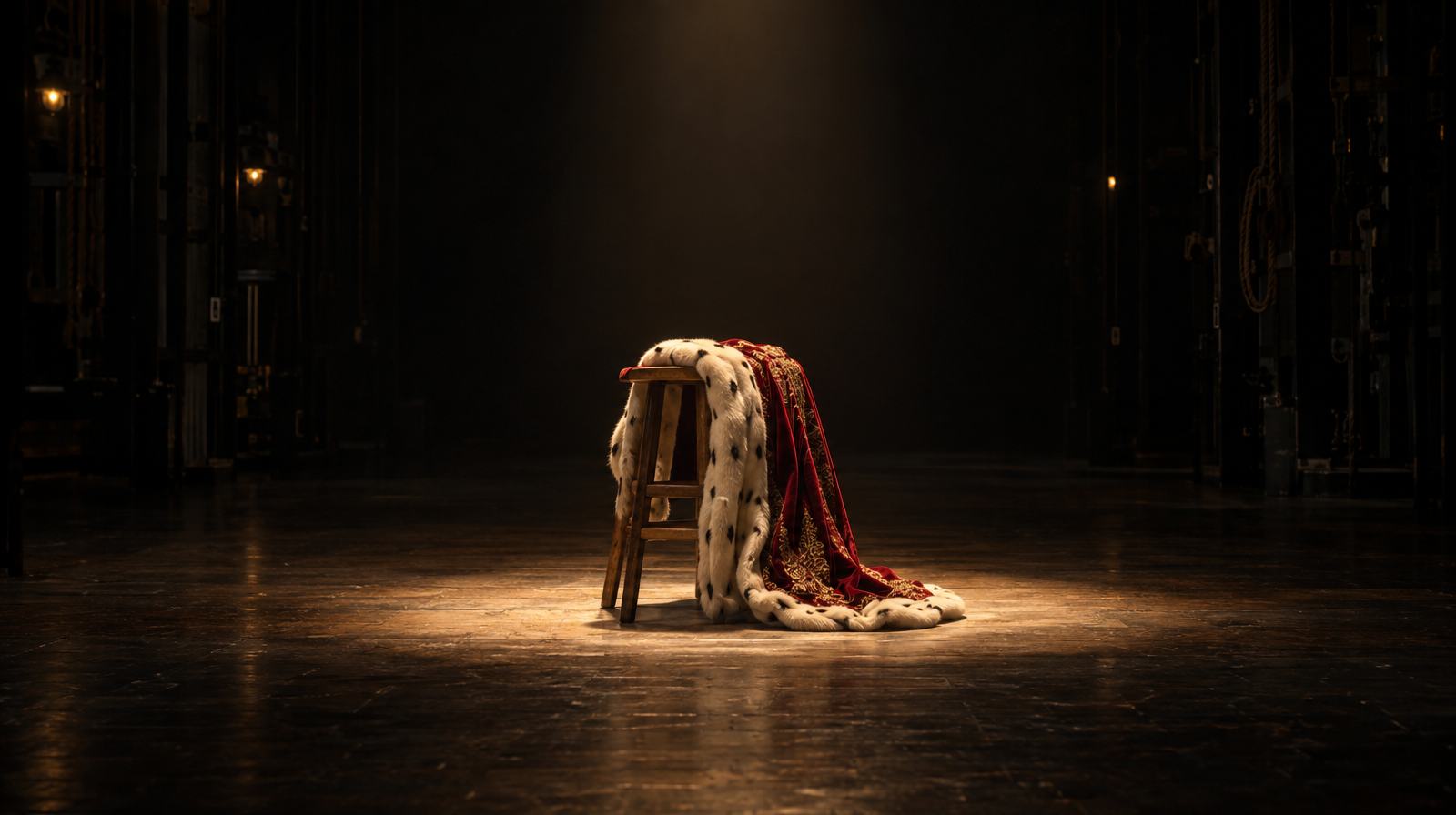
It fits a habit Hamilton relies on more than most musicals: using its ensemble for things a script has no other way to say. The company plays crowds and cabinet rooms, but it also plays abstractions — the pull of political ambition, the passage of years between scenes, the sheer velocity of a life lived, as the show keeps insisting, like there's not enough time. None of that is spoken. It is danced into the audience's understanding before anyone consciously registers what happened. The Bullet is the sharpest version of that habit, because unlike a crowd or a cabinet room, it never resolves into anything literal. It is abstraction all the way down, for the entire show, and it is the one piece of that abstraction an audience is left to interpret almost entirely on its own. The same visual grammar works in reverse elsewhere in the show, where it's stillness rather than motion that does the work — a king who never moves, staged as the one fixed point in a production that never stops.
What happened inside the choreography is a different story, and it comes from the person who first performed it. Ariana DeBose, the original ensemble member who originated the role, has described her own reaction to being cast in it in plain, almost deflating terms: "OK, I'm playing an inanimate object. Awesome." That is not a performer describing a rich character. That is a performer describing a stage direction. A bullet is not a part; it is a prop that happens to have legs.
DeBose did not leave it there. In a 2025 interview with NBC Insider, she described the moment she decided the role needed to be something more specific than "object in motion." "What about an omen of death?" she recalled thinking. "Maybe she's like death itself." That reframing — from projectile to omen, from physics to myth — is not a note anyone gave her. It is not in Lin-Manuel Miranda's lyrics, which never describe the Bullet at all, and it is not, by her own account, something the creative team assigned her either. She built it herself, privately, and then performed it eight times a week without necessarily telling anyone what she was actually doing up there.
The detail that makes this more than a nice anecdote is what DeBose says happened next: nothing. No one adjusted the choreography to reflect her interpretation. No one credited it. As she put it, "no one but me knew that. In fact, to this day, I'm pretty sure the creative team is like, 'What are you talking about?'" The single most haunting reading of one of the show's most memorable images — that death itself has been quietly moving through Hamilton's story since the moment he first put himself in danger — was authored by an ensemble performer, alone, and may still be news to the people who get billing for the choreography.
This is worth sitting with, because it runs against how audiences are trained to think about who makes a show. A Playbill lists a book writer, a composer, a director, a choreographer. Those credits describe real, load-bearing authorship — Blankenbuehler genuinely did design the mechanics of the Bullet, the slow-motion tracing, the recurring path across the stage. But mechanics are not meaning. The choreography specifies how a body moves; it does not specify what an audience member two hundred feet away should feel is watching them. That gap, between the instruction and the interpretation, is where DeBose did her actual work, and it is a kind of authorship the program has no line for.
It is tempting to call this a loophole in how theatre credits get assigned, but that undersells what is actually going on. A script is not a complete set of instructions the way a blueprint is; it cannot be, because the medium it describes is a live human body doing something in front of other human bodies, eight times a week, for years, often with different people in the role. Every production of every play depends on performers filling gaps the text cannot close on its own — a line reading, a pause, a glance the stage directions never mention. What makes the Bullet unusual is not that a performer added interpretation. It is how much interpretation was required, and how completely the specific content of that interpretation was left to her alone, with a role that has no dialogue to constrain it and no established real-world referent to guide it. Hamilton had a name and a documented life before Lin-Manuel Miranda wrote a word about him. The Bullet had nothing. She had to be invented from a stage direction that amounted to "walk this way, slowly," and DeBose is the one who decided what "this way" meant.
None of this makes Blankenbuehler's contribution smaller. Somebody still had to decide that the story needed a wordless, recurring visual thread for death at all, still had to build the physical vocabulary — the traced arc, the slowed time, the way the rest of the ensemble reacts to her presence — that made DeBose's interpretation legible to an audience that never heard her explain it. His design is the reason her idea had anywhere to live. But design and meaning are two different jobs, and Hamilton's most quietly devastating image is the product of both, credited to only one of the people who actually did the work.
This also complicates a fairly common way of talking about long-running shows, which is to treat "the show" as a fixed object that exists independently of whoever happens to be performing it that night. That framing works well enough for the parts of Hamilton fixed by lyrics and dialogue — the words don't change from cast to cast. It works much less well for a role built entirely out of movement and private intention, with nothing on the page to anchor it. Two different performers can both dance the exact choreography Blankenbuehler set, hit every mark correctly, and still be doing two different things, because the choreography was never the whole job. The show a given audience actually sees on a given night depends on a layer of authorship that changes with the cast, is never printed in a Playbill, and in this specific case, was reportedly never even fully disclosed to the people running the production.
What should an audience do with this, watching the show now, whether live or on a cast recording that cannot capture any of it? Probably not treat "the Bullet is death itself" as the show's official, intended reading — Miranda's script never says so, and by DeBose's own account, the people who could confirm it never fully knew it either. It is closer to a piece of folklore that happens to be true: a fact about how this specific production came to mean what it means, passed down through interviews rather than through the text. Whether every performer who has since stepped into that ensemble track has inherited DeBose's specific interpretation, or quietly built their own version of it, is a question the public record does not answer — and it is worth resisting the urge to assume an answer just because the first one makes a better story.
This much is not actually in question: the moment in Hamilton most people describe as chilling, the one where a silent figure paces toward a man who does not see her coming, was not fully written by anyone whose name appears above the title. It was completed, alone, by a performer deciding what a stage direction should mean before anyone told her whether she was right. That is not a flaw in how the show was made. It is a fairly precise description of what live performance actually is, once you stop assuming that everything an audience feels was put there on purpose by someone credited for it.